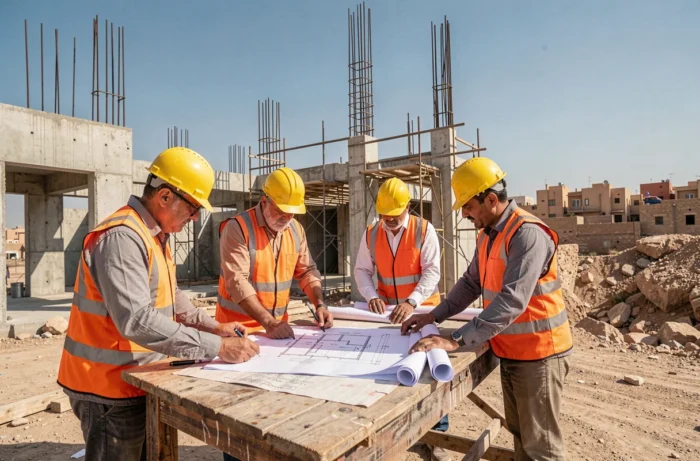
The construction cycle open in Constantine for several months is redistributing the budgetary and technical priorities of the wilaya. Between hospital delivery under time constraints, tunnel breakthroughs in unstable geological terrain, and the development of a large-scale urban hub, the phasing decisions dictate the actual pace of progress, well beyond official announcements.
CHU de Constantine: partial delivery and reception constraints
The university hospital complex of 500 beds is the focus of attention for project owners. During a visit reported in October 2026, the Minister of Housing set a firm deadline: reception of the educational pavilions and life services by the end of February 2027 at the latest.
This scheduling requirement reflects a choice for delivery in batches rather than a global reception. The university pavilion and research laboratories remain on a more distant horizon, which implies a coexistence between operational phases and construction phases, along with the security and traffic constraints this entails on a hospital site.
Several structural projects in the wilaya are regularly documented. We note that the work on the La Gazette de Constantine site provides useful tracking of these operations, particularly for the hospital aspect and major roadworks.
Tunnel de Djebel El Ouahch: geological risks and budget reassessment
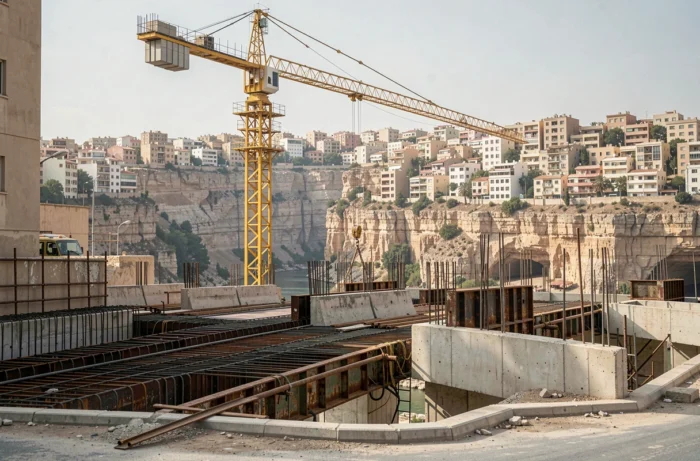
The Djebel El Ouahch tunnel crystallizes the difficulties inherent in underground structures in an unfavorable geological context. The straight tube, whose progress had remained slow before the interruption, is still awaiting the finalization of financial and administrative procedures as well as a budget reassessment for work to effectively resume.
The landslides encountered along the route partly explain the blockage. This type of hazard requires additional geotechnical assessments, a recalibration of excavation methods, and, in most cases, a significant cost overrun compared to the initial budget.
Resumption therefore depends on a precise administrative sequence: validation of the reassessment, reactivation of construction contracts, mobilization of companies. Each step delays the resumption of work by several months. The tunnel remains a marker of the complexity of major roadworks in the region.
Urban hub of Sissaoui: phasing of networks and public facilities
The program for 20,000 housing units planned at the Sissaoui urban hub is not limited to the construction of buildings. The real bottleneck, identified during the ministerial visit, concerns the completion of network studies (sanitation, drinking water, electricity) and the main and secondary roads.
Without these networks, the delivered housing units would remain uninhabitable. The phasing must ensure that connections precede or accompany the delivery of buildings, which requires coordination among several sectoral project owners. The announced facilities at the hub complement the setup:
- Schools to accommodate the projected population of the new neighborhood
- A polyclinic sized for local health needs
- A national security post integrated from the urban design of the site
This approach of simultaneous facilities avoids the classic model of dormitory towns delivered without services. The challenge remains adherence to the study schedule, a prerequisite for the effective launch of development works.
Road infrastructures: duplication of RN 79 and inter-wilaya connections
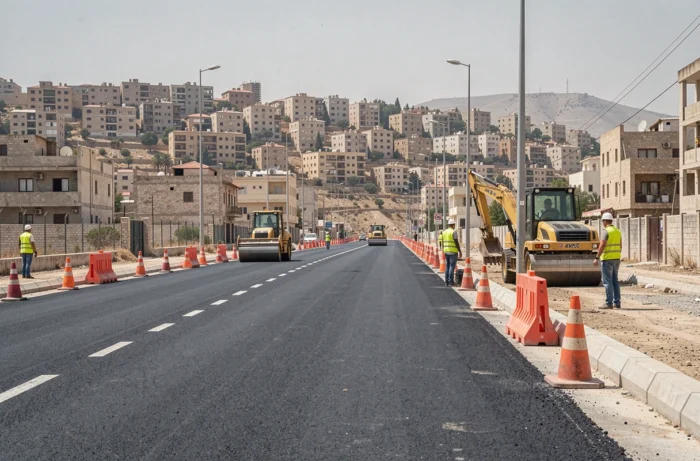
The commissioning of the duplication of the National Road No. 79 over 16 kilometers between Constantine and Oum El Bouaghi is one of the most visible achievements of the public works program. This infrastructure accommodates dense traffic on a strategic axis and opens up several previously poorly served localities.
The duplication of National Road No. 27 follows the same logic of interconnection between wilayas. These two operations fall under the public works sector, which is establishing itself as the main lever for the territorial modernization dynamic in Constantine.
The expected benefits go beyond mere travel time savings:
- Reduction of accidents on previously congested and bidirectional sections
- Direct socioeconomic benefits for neighboring municipalities (access to markets, public services)
- Improvement of service to rural areas as part of the 2026 decongestion program
Rehabilitation of the old town: launch of the 5th site
The project to rehabilitate the medina of Constantine is entering a new phase with the upcoming launch of work on the 5th site.
Urban rehabilitation in an old fabric poses specific constraints: restricted access for machinery, fragile buildings requiring appropriate reinforcement techniques, coexistence with residents during the works.
The articulation between heritage rehabilitation and modernization of underground networks (water, sanitation) remains the most delicate technical point. Intervening on outdated pipelines under classified or fragile buildings requires rigorous sequencing to avoid structural disorders.
Constantine combines projects with varying scales and technical risks, from tunnels in unstable terrain to the restoration of century-old buildings. The common factor remains phasing: the ability to sequence studies, contracts, and execution without interruption conditions the credibility of the entire construction and rehabilitation program undertaken by the wilaya.