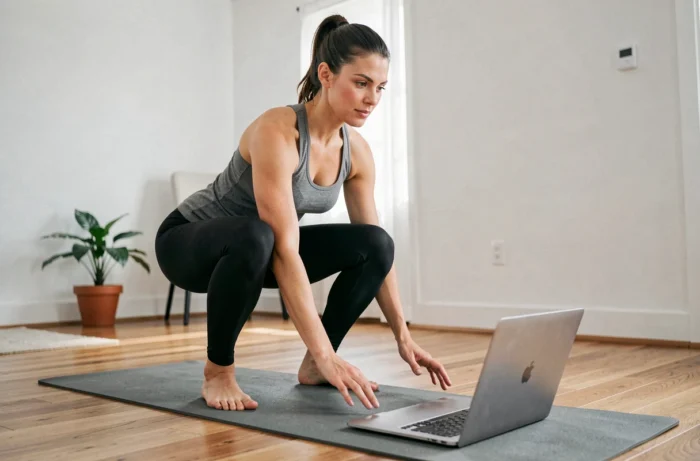
Online fitness has ceased to be a backup plan for several years now. Between free platforms on YouTube, subscription apps, and coaches offering personalized follow-ups via video, the options have become structured enough to compete with traditional gyms. For a beginner, this abundance presents a concrete problem: where to start without getting injured, discouraged, or wasting time on an unsuitable program.
The WHO recommends that inactive individuals start with small amounts of activity and then gradually increase. This principle of gradual progression, often overlooked by “30-day transformation” programs, is crucial for medium-term success.
Progression and Sedentary Behavior: What an Online Class Alone Doesn’t Solve
A point rarely addressed in home fitness guides concerns the time spent sitting outside of sessions. The WHO clearly distinguishes between physical training and reducing sedentary behavior. A thirty-minute cardio class does not compensate for eight hours of being still in front of a screen.
Practically, this means that an online program benefits from being complemented by micro-activities spread throughout the day: walking between meetings, light stretching every hour, standing during a call. These parallel habits do not replace training, but limiting sedentary time improves the overall results of a beginner program.
Platforms that integrate mobility reminders or short sessions of five to ten minutes facilitate this approach. Other resources, such as the Sport en Ligne portal, list programs that combine structured sessions with daily mobility routines.
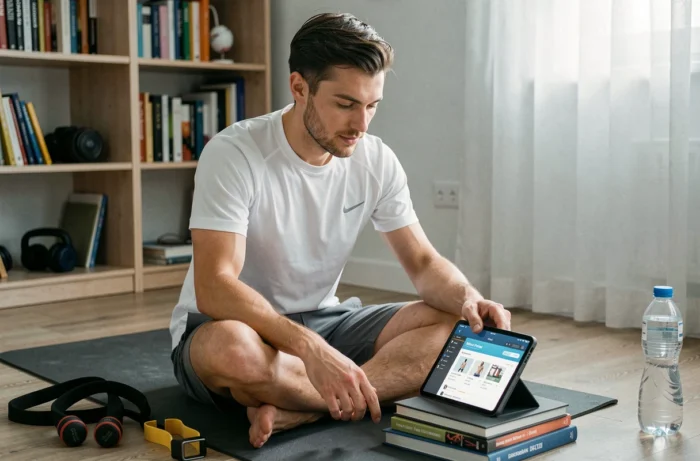
Beginner Fitness Program: Combining Cardio and Strength Training
Many beginners focus their first weeks on pure cardio (HIIT, dance, running in place). However, the WHO’s recommendations combine aerobic activity with regular strength training, even for those who are just starting out.
An balanced program therefore alternates at least two types of sessions:
- Cardio sessions (brisk walking, stationary cycling, online dance classes) that engage the cardiovascular system and facilitate energy expenditure
- Bodyweight strength sessions (squats, adapted push-ups, planks) or with simple equipment like resistance bands, which preserve muscle mass and improve posture
- Shorter mobility or yoga sessions that serve both as active recovery and joint range of motion work
For the first week, two to three sessions of twenty to thirty minutes are sufficient. Progression is achieved by first adding an additional session, then increasing the duration or intensity. Adding volume before adding intensity remains the basic rule to avoid common joint or muscle injuries among beginners.
Choosing the Right Class Format According to Your Level
Live classes offer a time frame that helps maintain consistency. Replay videos allow you to pause, review a movement, and adjust the pace. For a true beginner, replay has a technical advantage: the ability to slow down the execution of a poorly mastered exercise.
Apps with algorithmic tracking (which adjust difficulty based on user feedback) are multiplying. Their relevance depends on the quality of the data provided. A beginner who overestimates their abilities in the initial questionnaire will receive a program that is too difficult, which can lead to dropout within the first two weeks.
Online Coaching: Check the Coach’s Qualifications
In France, paid sports instruction is regulated by the Sports Code. A coach offering paid online classes must hold a professional sports educator card. It is possible to verify the validity of a sports educator’s card before committing to a paid program.
This requirement also applies to video sessions and personalized programs sold online. Free content distributed on YouTube or Instagram is not subject to the same constraints, which explains the disparity in quality between channels.
What the Professional Card Does Not Guarantee
The card attests to a recognized qualification, not a specialization in remote training. A coach qualified in gym-based strength training does not necessarily have experience in postural correction via screen. The limitations of video coaching are real: the coach only sees one camera angle, often fixed, and cannot correct knee or back placement as precisely as in person.
For a beginner, one or two individual video sessions with a qualified professional, before transitioning to group online classes, help lay the technical foundations for fundamental movements (squat, plank, lunge).
Minimal Equipment and Space Organization for Home Training
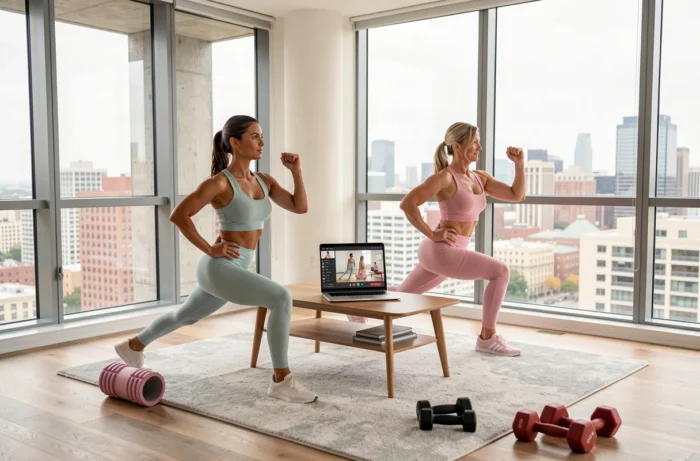
The list of equipment needed to start online fitness is quite simple:
- A sufficiently thick exercise mat to protect joints on the floor, especially on hard tiles or hardwood
- A pair of resistance bands of different strengths, which replace dumbbells for most beginner strength exercises
- A free space of about two meters by two, clear of any furniture at arm or foot height
- A stable internet connection and a screen large enough to see demonstrations without squinting (a phone placed on the floor two meters away is not sufficient)
The training space must be ready before starting the video. Moving a coffee table in the middle of a circuit training breaks the rhythm and increases the risk of injury. Preparing your space the night before, if the session is scheduled for the morning, removes a psychological barrier that is often underestimated.
Online fitness works when the program respects the practitioner’s progression, when the coaching is qualified, and when the home environment is suitable. These three conditions, combined with a reduction in sedentary time outside of sessions, provide a realistic framework for maintaining a regular practice over several months rather than just a few weeks.