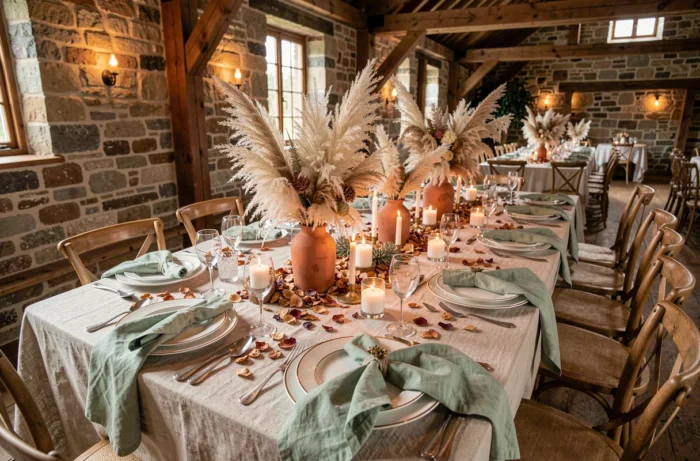
The decoration of a wedding in 2022 is not just about choosing a color palette on Pinterest. Before even thinking about flowers or fabrics, there is often overlooked parameter that conditions everything else: the venue’s regulations. No open flame candles, prohibited wall fixtures, banned confetti, unauthorized arches – these constraints must be checked in advance, or else the entire decorative project may need to be revised.
Venue regulations and wedding decoration: what blocks in practice
Reception halls, town halls, and estates impose specific rules that vary greatly from one site to another. Some prohibit flying lanterns for fire safety reasons, while others refuse any wall or ceiling fixtures to protect the built heritage.
The problem arises when the decorative theme has been designed without considering these restrictions. A decor planned around aerial suspensions or open flame chandeliers becomes unusable in a venue that does not accept them. Therefore, checking the internal regulations is the first step before any decorative design.
Meanwhile, several couples preparing their reception consult wedding decoration trends 2022 on Wedding News to refine their project, but adapting to the venue remains the decisive filter between an appealing idea and a feasible decor.
Modular decor for indoor-outdoor: a trend born from weather uncertainties
Among the notable evolutions in wedding decoration in 2022, the design of modular decor has emerged as a concrete response to a risk that many couples underestimate: rain on the day of the ceremony.
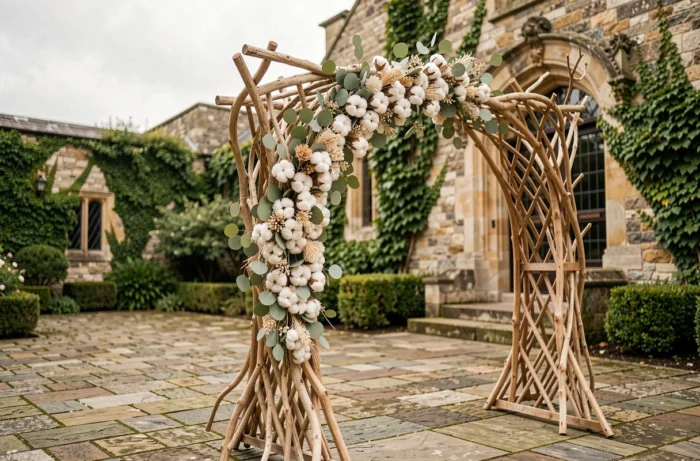
The principle is simple. An arch, a set of fairy lights, or a floral scenography are designed to work in two configurations: outdoors in good weather, indoors in case of bad weather. The visual identity of the wedding remains consistent regardless of the scenario.
In practical terms, this requires choices of materials and structures. The elements must be lightweight, quickly disassemblable, and compatible with spaces of different dimensions. Freestanding metal or wooden arches lend themselves well to this logic, unlike installations requiring fixed anchor points.
This approach also changes the work of florists and decorators, who must plan easily transportable compositions rather than fixed monumental installations.
Local and seasonal wedding flowers: sustainable trend or fashion effect
The floral trend that has marked recent weddings favors flowers grown locally and available in season. Potted arrangements are gradually replacing imported single-use bouquets, and nuanced monochrome palettes dominate reception tables.
Two motivations intersect. The first is economic: seasonal flowers cost significantly less than imported varieties. The second relates to environmental concerns, with a desire to reduce floral waste after the reception.
The reuse of flowers is now considered from the logistical design stage. Ceremony arrangements can be dismantled and then redistributed on dinner tables or given to guests at the end of the evening. This constraint requires designing modular compositions, which steers the style toward more compact and transportable formats.
- Favor local seasonal varieties (peonies in spring, dahlias in summer, chrysanthemums in autumn) to control the budget and ensure freshness
- Opt for potted or individual vase compositions, easily movable between the ceremony and reception
- Plan a redistribution circuit for the flowers at the end of the day to limit waste
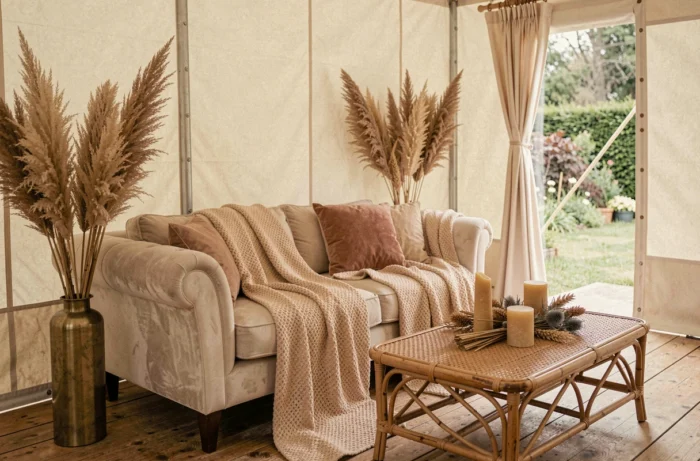
Lighting as the main lever for ambiance at the reception
The accumulation of decorative objects on tables and in the room gives way to an element often relegated to the background: lighting. Hanging garlands, LED candles, paper or fabric suspensions transform the atmosphere of a place without cluttering the space.
Lighting affects the entire room where floral decoration remains localized. A warm light blanket above the tables creates an enveloping effect that table centerpieces, no matter how well-crafted, cannot create alone.
This trend also has a practical advantage for venues that restrict wall fixtures or heavy installations. Lightweight garlands suspended from freestanding structures circumvent most prohibitions while providing a strong visual impact in photographs.
Field feedback varies on one point: the combination of artificial lighting and natural light at the end of the day. In receptions that start early, the transition between daylight and evening ambiance requires a gradual adjustment, sometimes difficult to achieve without professional equipment.
Colors and style: what the palette choices reveal in 2022
The dominant colors of weddings in 2022 reflect a shift towards neutral and earthy tones. Nude, sand, ivory, and linen form the base of most palettes, complemented by touches of terracotta or powder pink.
Black also makes an appearance, used in small touches on stationery, ribbons, or table elements. The total black and white look remains marginal but is gaining visibility in weddings with a clearly minimalist style.
In contrast, bright and saturated colors (lemon yellow, fuchsia, electric blue) remain rare in reception themes. When they do appear, it is generally as an accent on a unique element (napkins, menu, accompanying flowers) rather than as a dominant color.
- Neutral base (ivory, linen, sand) for tablecloths, chairs, and structures
- Accent in terracotta, powder pink, or lilac on flowers and stationery
- Optional touches of black or gold to enhance without overwhelming
The decoration style that emerges from these choices leans towards minimalism, with raw materials (wood, linen, stone) and clean shapes. Fewer objects, better chosen, in coherent tones – this is the guiding principle that runs through most recent weddings, beyond the labels (bohemian, rustic, romantic) that are often interchangeable.