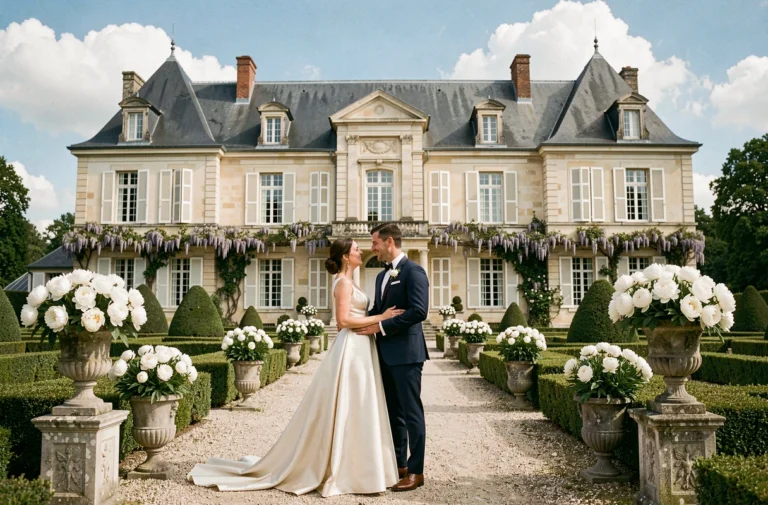
When you start thinking about wedding decoration, the first instinct is often to collect images on Pinterest or Instagram. The problem is that you end up with an incoherent mood board, mixing rustic floral arches, minimalist centerpieces, and industrial string lights. Before choosing any item, you need to set a clear intention: what sensory memory do you want to leave for the guests?
Wedding Scenography: Think Journey Before Thinking Objects
A couple decorating a barn does not do the same work as a couple decorating an urban rooftop. The constraints of the venue dictate half of the choices. For a few seasons now, there has been a clear shift: decorators no longer just talk about “theme” or “palette,” but about overall scenography oriented towards guest experience.
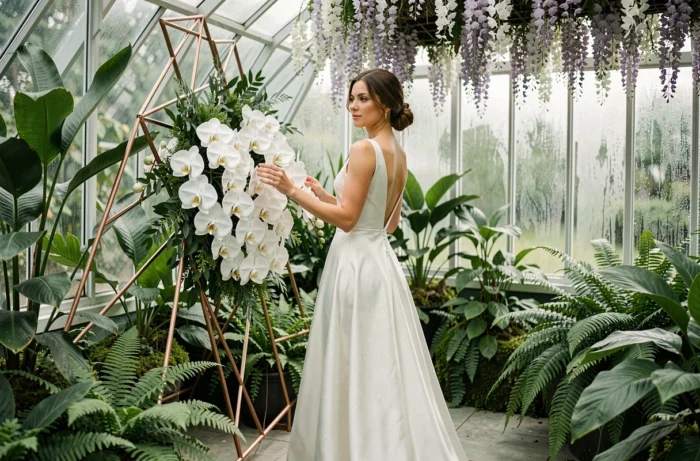
Concretely, this means planning the flow of guests in the space, anticipating key visual moments (arrival, cocktail, first dance), and orchestrating the lighting according to the time of day. An outdoor dinner at dusk does not need the same string lights as a meal under a glass roof at noon.
You can explore wedding decoration on Rêve 2 Mariage to spot elements that fit this type of scenographic approach, rather than accumulating accessories without a guiding thread.
Sound, scents (scented candles placed at passage points, aromatic herbs on tables), and even the rhythm of the playlist contribute to this scenography. A successful decor is not just photographed: it is experienced.
Bold Color Palettes: Moving Away from Pastels to Make an Impression
Terracotta, sage green, blush, off-white: these shades have dominated weddings for years. They remain elegant, but they saturate feeds and reception halls. The emerging trend that breaks away is color blocking applied to wedding decoration.
The principle is simple: instead of blending three similar shades into a soft gradient, you lay down large blocks of contrasting colors. A butter yellow table runner on a midnight blue tablecloth. Bright orange napkins on white dinnerware. The effect is immediate and very readable in photographs, even from a distance.
How to Avoid Bad Taste
Color blocking works when you limit the palette to two or three strong colors, no more. You choose a dominant color (tablecloths, drapes), an accent color (napkins, chair ribbons), and keep white or black as a neutral base.
Feedback varies on this point: some decorators recommend testing the palette in real conditions, with the venue’s lighting, before finalizing. A beautiful color in natural light can turn dull under party hall neon lights.
- Butter yellow paired with navy blue: a combination spotted in several recent weddings, mentioned as a strong trend by specialized magazines
- Deep red and cream: more classic but revisited in large blocks rather than small discreet touches
- Emerald green and fuchsia pink: a duo that works particularly well in venues with a lot of wood or stone
Centerpieces and Floral Decoration: Incorporating Edible Fruits and Foliage
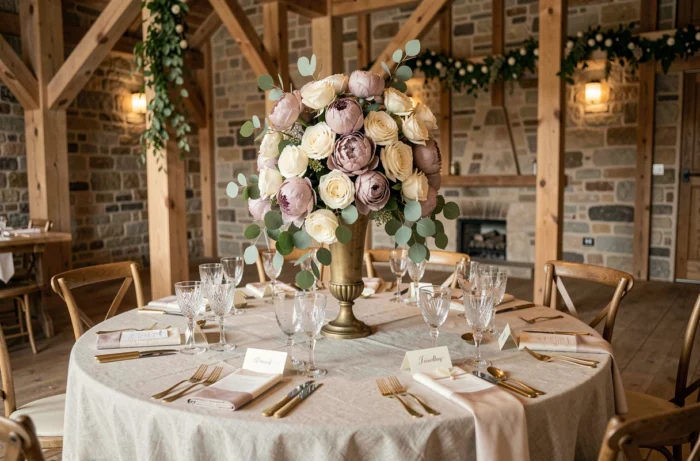
100% cut flower arrangements remain a classic, but their cost rises quickly and their lifespan is limited to the day. An alternative that is gaining ground is to mix flowers, citrus, and seasonal fruits in centerpieces.
Practically, you place lemons, open pomegranates, or bunches of grapes among the floral stems. The result adds volume, color, and a texture that flowers alone do not provide. At the end of the evening, guests can even take home a citrus fruit, which also solves the question of small table gifts.
Dried Flowers and Grasses: Still Relevant?
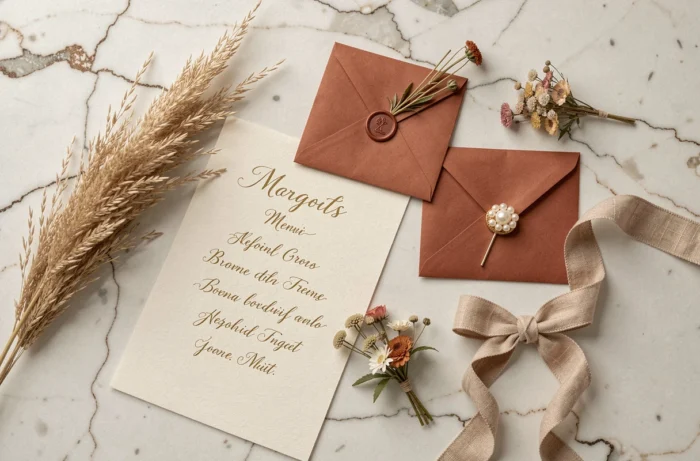
Pampas grass and dried flowers have seen a peak in popularity. They remain useful for a winter wedding where fresh flowers are expensive, but their omnipresence is starting to wear thin in rustic venues. If the venue is already rustic (barn, Provençal farmhouse), it’s better to bring contrast with colorful fresh flowers rather than doubling the “natural” effect with dried ones.
For an outdoor ceremony, mixed arrangements (fresh and dried) hold up better to heat than a bouquet that is 100% fresh. You gain in durability without sacrificing the lively aspect of the table.
Decoration for Secular Ceremony: Creating a Focal Point Without a Standardized Arch
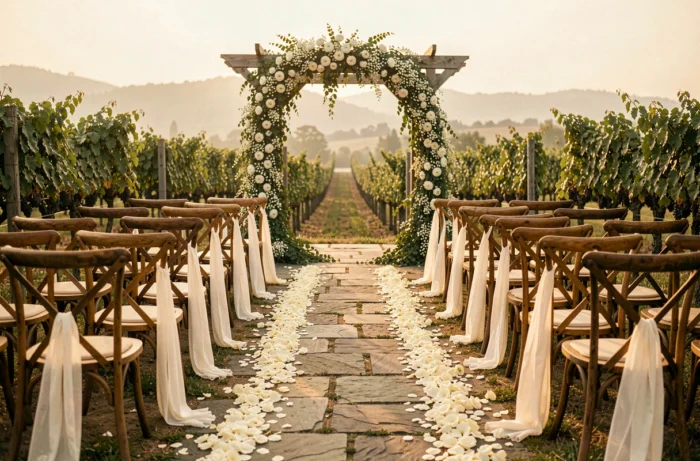
The floral arch has become the default reflex for secular ceremonies. It works, but it can be found in almost every wedding. Other options create just as strong a focal point.
- An existing tree at the venue, dressed with ribbons, string lights, or suspended frames containing photos of the couple
- A textile panel (sheer, dyed linen) stretched between two posts, serving as a backdrop without the rigidity of a wooden structure
- A suspended installation above the aisle (cloud of flowers, lanterns, origami) that draws the eye upward and alters the perception of space
The choice mainly depends on what the venue offers. A garden with large trees does not need an additional arch. The most memorable decor is the one that amplifies what already exists rather than imposing an imported structure.
Lighting and Evening Ambiance: The Detail That Changes Everything
Lighting is probably the most underestimated item in a decoration budget. Candles placed at different heights (floor lanterns, chandeliers on tables, hanging lanterns) transform a mundane room into a warm place as night falls.
For indoor receptions, dim ambient lighting with warm white LED string lights remains the most reliable solution. Avoid multicolored DJ-style spots, which crush the carefully chosen decorative palette.
Outdoors, string lights stretched above the tables create a luminous ceiling that delineates the reception area. It also serves as a visual cue for guests: they instinctively know where to head.
The most successful wedding decoration is not the one that accumulates the most elements. It is the one where every choice, from the color of the napkins to the luminous path of the evening, responds to the same intention. Three coherent decisions are worth more than twenty scattered accessories.