We’ve all experienced that moment: searching for a gift for a birthday or a housewarming, spending an hour on marketplaces, and ending up ordering an over-packaged item made on the other side of the world. The problem isn’t the lack of eco-friendly gift options; it’s more about distinguishing truly sustainable products from mere marketing claims.
Since the law of May 10, 2024, vague environmental claims expose sellers to heavy penalties. It goes without saying that sorting is also happening on the regulatory side.
Greenwashing on gifts: what the law now prohibits
When looking for eco-friendly gift ideas online, you come across dozens of product listings displaying “eco-friendly” or “green” without any proof. This practice is set to come to an end.
Generic terms like “environmentally friendly,” “ecological,” or “eco-responsible” will be banned from product listings, packaging, and advertisements, unless the seller can demonstrate excellent environmental performance recognized by a type I label compliant with EN ISO 14024 standards (European Ecolabel, NF Environment, for example).
The same logic applies to the term “carbon neutral product”: without accessible documentation for the consumer, it’s a misleading commercial practice. Penalties can reach up to 300,000 euros for individuals and up to 10% of annual revenue for legal entities.
It is therefore recommended to check for the presence of an official label before purchasing a gift presented as responsible. Stores like marie-carotte.fr select their products based on documented criteria, making it easier to spot them when you don’t want to spend twenty minutes analyzing each listing.

Zero waste gifts that are truly useful in daily life
The classic trap of the “zero waste” gift is giving yet another tote bag or a stainless steel straw that will end up in a drawer. For an eco-friendly gift to be effective, it must replace a disposable item that the person already uses. We start with the usage, not the concept.
Concrete criteria for choosing a useful zero waste gift
- The item replaces something disposable that the recipient regularly buys (washable paper towels for someone who cooks, bee wraps for someone who wraps leftovers)
- The material is durable and repairable: certified wood, food-grade stainless steel, organic fabric with reinforced seams, no composite plastic that is impossible to recycle
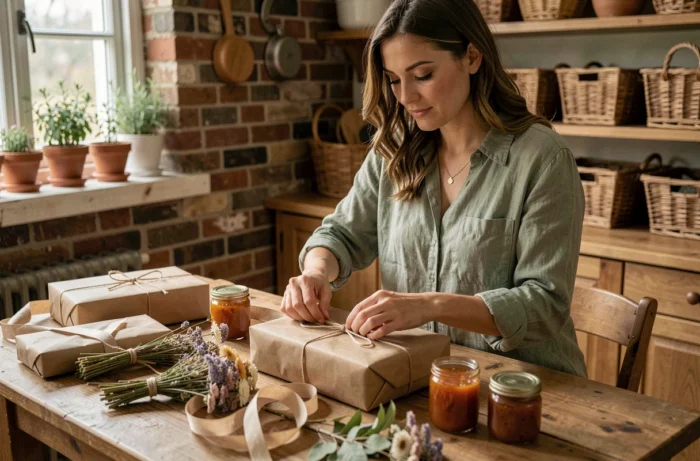
- The packaging is minimal or reusable, ideally a furoshiki or recycled kraft paper rather than a cardboard box lined with foam
- The manufacturing is traceable: identified workshop in France or Europe, not a vague mention of “made responsibly”
A zero waste gift set personalized according to the recipient’s habits is much more likely to be adopted than a generic kit. Someone who never cooks won’t use a set of food covers, no matter how organic they are.
Intangible gifts and experiences: the underestimated angle
We often think eco-friendly gift = physical object made from natural materials. Offering an experience rather than a product remains the most radical way to reduce the environmental footprint of a gift. No transport of goods, no packaging, no end-of-life management.
Experiences that work for all occasions
A local organic cooking workshop, a pottery class, a day at an educational farm for a child, a subscription to a producer’s basket. These gifts create a memory without generating waste. For a birthday or a celebration, a gift card usable at committed retailers also offers the freedom of choice without the risk of missing the mark.
The other concrete advantage: no issues with size, taste, or duplicates. It eliminates product returns, which represent a logistical and environmental cost rarely mentioned.

Recycled and second-hand products: spotting quality
Giving an item made from recycled or second-hand materials is no longer a taboo, provided the presentation is well done. A bag made from recycled tarpaulin, a piece of jewelry made from reclaimed metal, or a second-hand book in excellent condition make for original gifts with a real story behind them.
Second-hand works particularly well for books, decor, and vintage fashion. For products made from recycled materials, we check that the percentage of recycled content is clearly indicated. A product labeled “made from recycled plastic” that contains only a fraction of recycled material is exactly the type of claim that the regulation is now targeting.
Quick checklist before giving a recycled gift
- The percentage of recycled material is mentioned on the product listing or label
- The item is functional and aesthetic (we’re giving a gift, not making a political statement)
- The price reflects the actual quality, not an unjustified “green” premium
Organic and natural gifts made in France
Natural cosmetics, vegetable wax candles, artisanal soaps, organic tea or spice gift sets: these products check multiple boxes at once. Local production, traceable ingredients, compact formats that are easy to ship. An organic cosmetic gift set made in France remains one of the most popular eco-friendly gifts, across all budgets.
The useful reflex: look for the mention of the workshop or manufacturing laboratory. “Made in France” without a specific address deserves the same scrutiny as “eco-responsible” without a label. Serious artisans display their production location, their organic certifications (Cosmos Organic, Nature & Progrès), and the complete composition of their products.
Giving a responsible gift does not require an extravagant budget or endless research. The key lies in two checks: does the product replace a real use of the recipient, and are its environmental claims documented? When these two conditions are met, the gift is likely to be useful for a long time and not end up at the back of a closet by January.