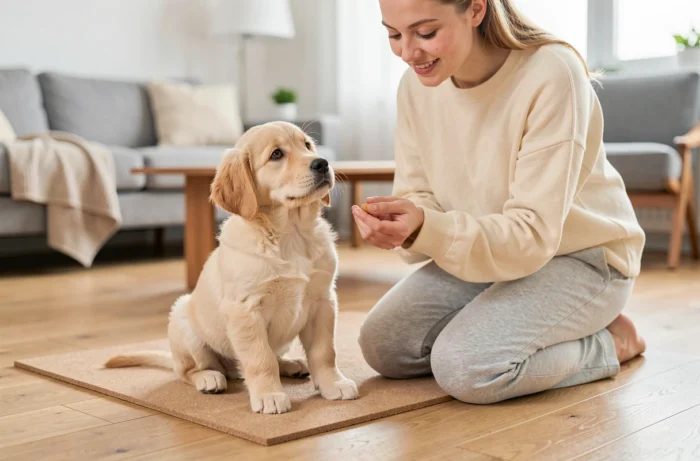
A 2-month-old puppy typically urinates every two hours. This is not a behavioral issue; it’s a physical limitation: its bladder is simply too small to hold more. Understanding this biological constraint changes the approach to potty training. Instead of correcting accidents, we anticipate them by aligning outings with the puppy’s natural rhythm.
The 2-Month-Old Puppy’s Bladder: A Clock That Dictates Everything Else
Most guides talk about patience and consistency. Few explain why. At 8 weeks, a puppy cannot hold it for more than 2 hours during the day. The retention capacity increases by about one hour for each month of age, reaching 6 to 8 hours by 6 months.
This means that any potty training strategy is based first on a simple calculation: take the puppy out before it reaches its limit. If you wait for it to signal its need, you will arrive too late. At this age, the signal and the action are almost simultaneous.
Have you noticed your puppy circling or sniffing the ground insistently? This is often the only warning you will have, and it lasts just a few seconds. To delve deeper into this approach, you can check how to make a puppy clean on British & Co, which details the signals to look for.
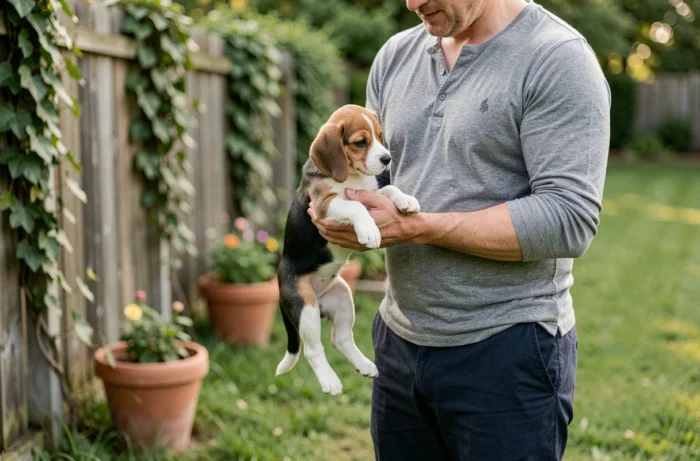
Outing Protocol Aligned with the Puppy’s Clock
Instead of taking the puppy out “often” (a vague piece of advice seen everywhere), schedule outings at fixed intervals. For a 2-month-old puppy, an outing every 1.5 to 2 hours during the day is the minimum foundation.
In addition, there are outings triggered by specific events. This is where the method becomes mechanical and reliable.
- Upon waking, including after every micro-nap during the day: the puppy’s bladder is consistently full at this time
- After each meal, within 5 to 15 minutes: digestion stimulates the elimination reflex
- After each play session or excitement: physical activity speeds up transit and increases pressure on the bladder
- Just before bedtime, to maximize the night stretch
Each outing should be in the same place. The puppy associates the smell of the location with the act. Stay still and quiet while it sniffs. As soon as it eliminates outside, reward immediately with a treat or a firm pet. The reward should come within two seconds of the act, not upon returning to the house.
Why the Timing of the Reward Changes Everything
A 2-month-old puppy has no capacity for delayed reasoning. If you praise it upon returning, it associates the reward with coming back, not with having eliminated outside. Rewarding on the spot, in the moment, creates the correct link: “pee here = something pleasant.”
This mechanism is the basis of positive reinforcement applied to potty training. It works better than any punishment for a simple reason: the puppy does not understand punishment after the fact.
Managing the Night and Water Before Bedtime
Nighttime is when accidents are most discouraging. The puppy sleeps in a confined space (playpen, open crate, designated corner). It will naturally avoid soiling the place where it lies down, giving you a bit more leeway than during the day.
A practice endorsed by veterinarians is to remove the water bowl 1 to 2 hours before bedtime. This gives the puppy time to empty its bladder during the last outing. Be careful: this restriction only applies to the time leading up to night. The rest of the day, water should remain accessible at all times.
Should You Get Up at Night?
With a 2-month-old puppy, at least one nighttime outing is generally necessary. Schedule a wake-up about 4 hours after bedtime. Take the puppy out without talking, playing, or turning on all the lights. The goal is clear: eliminate, then go back to sleep. Any stimulation prolongs wakefulness and complicates the return to calm.
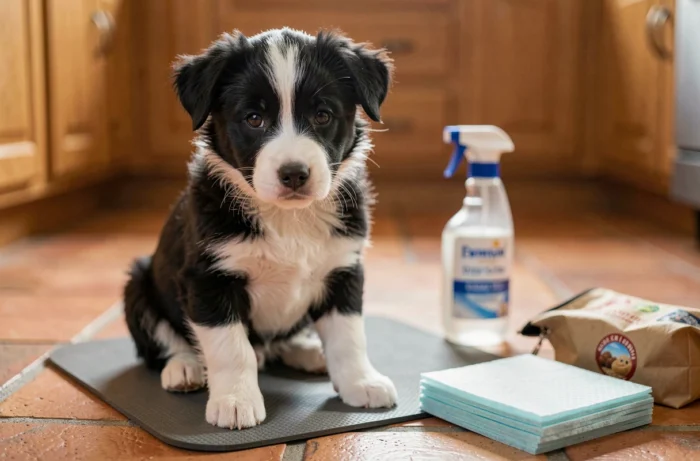
Accidents in the House: Cleaning to Prevent Relapse
Accidents will happen, even with a strict protocol. The correct reaction consists of three points: say nothing to the puppy, clean up, and take it out immediately.
The cleaning product matters more than you think. Ammonia or bleach-based cleaners should be avoided: their smell is reminiscent of urine to the puppy, which will return to eliminate in the same spot. An enzymatic cleaner destroys odor molecules and eliminates the olfactory marking. This is a modest investment that significantly speeds up learning.
If you catch the puppy urinating indoors, a brief “no” is enough. Carry it outside without yelling, wait for it to finish, then reward. Putting its nose in its mess produces only one thing: fear, not understanding.
Limiting Accessible Space for the 2-Month-Old Puppy
An entire apartment is a vast playground for a puppy that still cannot control its bladder. Restricting the space to one or two rooms reduces the number of accidents and makes supervision easier.
A puppy pen or a baby gate is sufficient. The puppy stays within your line of sight, allowing you to spot early signs (sniffing, circling) and take it out before the accident. The larger the space, the more likely you are to miss these signals.
As the puppy grows and accidents become less frequent, you can gradually open access to other rooms. This is a well-deserved expansion, not an acquired right from the start.
Potty training at 2 months is based on a principle imposed by biology: take the puppy out before it can no longer hold it. With outings scheduled every two hours, an immediate reward outside, and a reduced space indoors, most puppies understand the principle within a few weeks. Relapses are part of the process. They do not signify failure, just that the bladder has not yet caught up with the puppy’s willingness.