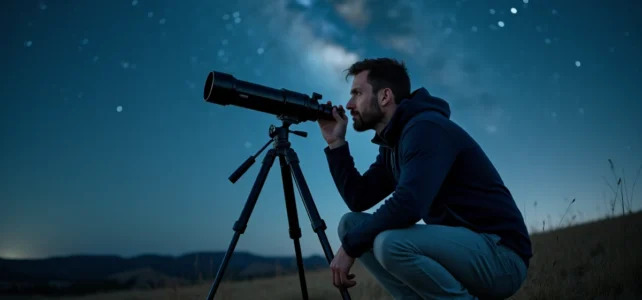
On a moonless night, far from a streetlight, one can see with the naked eye several thousand stars, the milky band of the Milky Way, and sometimes a bright planet like Venus or Jupiter. The problem is that most beginners in astronomy go out once, find themselves lost in this mass of bright points, and put their equipment away in a closet. A few field habits can radically change this first experience of sky observation.
Prepare your outing with astro-weather before looking up
Checking the regular weather is not enough. A sky forecasted as “clear” can be rendered blurry by atmospheric turbulence or humidity at altitude. Recent guides recommend using astro-weather tools like Meteoblue Astronomy Seeing, which display sky transparency and “seeing” (image stability) hour by hour.
Related reading : Discover the range of services offered by L'Essentiel Pro for professionals
Specifically, we check three parameters before heading out: low cloud cover, atmospheric turbulence, and humidity at mid-altitude. If turbulence is strong, planets shake in the eyepiece and lunar details become mushy. It’s better to postpone the outing than to spend two frustrating hours outside.
Consulting astro-weather has become a reflex even for beginners, just like checking the phase of the Moon. A gibbous or full Moon drowns out the majority of deep sky objects (nebulae, galaxies, star clusters) under its light. Therefore, we target nights around the new Moon for telescope observations, and reserve full Moon nights for lunar observation itself, where craters and seas appear with striking relief.
See also : Discover the must-have fashion trends of the season for a unique style
To find suitable equipment and reliable resources when starting out, one can explore https://www.astronomic.fr/ which gathers observation instruments and practical advice.

Naked-eye sky observation: learn the constellations before buying equipment
People often rush into buying a telescope right away. This is a common mistake. Without reference points in the sky, one doesn’t know where to point the instrument, and ends up sweeping the darkness randomly.
The first field skill is knowing how to identify about ten key constellations. The Big Dipper, Cassiopeia, Orion (in winter), Cygnus, and Scorpius (in summer) form a sufficient grid to navigate from star to star. This technique is called “star hopping”: starting from a known bright star and following a path of stars to the target object.
Mobile apps with augmented reality have transformed this learning. One points the phone at the sky and the app overlays the names of stars, planets, and constellations in real time. Most now offer a red night mode that preserves scotopic vision, this adaptation of the eye to darkness that takes about twenty minutes.
Preserving night vision, a detail that changes everything
The eye takes time to adapt to darkness, and a single glance at a white screen ruins this adaptation. One activates the red filter on the phone before going out, covers their headlamp with a red filter, and avoids looking at car headlights. This point may seem trivial, but it makes the difference between seeing three stars and seeing hundreds.
Binoculars or telescope to start astronomy: a field choice
The question comes up systematically, and the answer depends on what one wants to observe. Here are some concrete use cases:
- Binoculars (type 10×50) are suitable for sweeping large star fields, spotting open clusters like the Pleiades, tracking lunar craters, and observing Jupiter’s moons. They are lightweight, require no complex adjustments, and can also be used during the day.
- An entry-level astronomical telescope offers sufficient magnification to detail the surface of the Moon, the rings of Saturn, and the cloud bands of Jupiter. It is easy to transport and its setup remains simple.
- A Newtonian or Dobsonian telescope opens access to deep sky: nebulae, distant galaxies, globular clusters. However, it requires a longer setup time and a minimum of practice to collimate (align the mirrors).
For a first outing, it is often recommended to start with binoculars. They allow one to learn the sky without the constraint of adjusting a mount. Feedback on this point varies among practitioners, but the field consensus remains clear: it’s better to have binoculars used every week than a telescope taken out twice a year.
Starry sky reserves: the best spots for a first observation
Light pollution is the primary obstacle to observing stars. In urban areas, one can only see a handful of bright stars and the brightest planets. To access the Milky Way, nebulae, or galaxies, one must move away from cities.
In recent years, the number of areas labeled “starry sky reserve” or “dark sky park” has significantly increased in Europe. These parks offer structured initiation evenings with binocular loans, guided constellation spotting, and activities led by trained guides.
The advantage for a beginner is twofold. First, the quality of the sky is guaranteed by local regulations on public lighting. Second, the guidance avoids the pitfall of “I don’t know what to look at.” One learns in one evening what would take weeks to discover alone.
Preparing your outing in a dark sky reserve
A few practical precautions change the comfort of the evening:
- Bring warm clothing even in summer, as nights at altitude or in open areas cool down quickly after several hours of stillness.
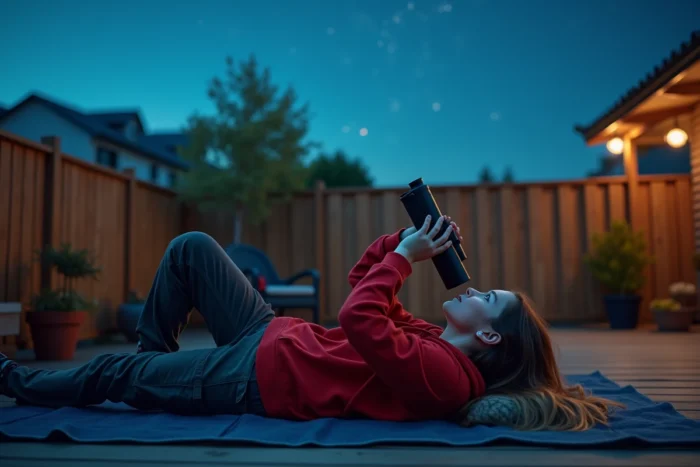
- Bring a ground blanket or a reclining chair to observe without straining your neck, especially when aiming for the zenith.
- Deactivate all bright notifications on the phone and cover any unfiltered screen in red.
Observing from a labeled site transforms the perception of the night sky. The difference between a peri-urban sky and a protected sky is immediate and often described as a visual shock by beginners who take the plunge. The Milky Way goes from a vague glow to detailed structure, and the first nebulae become accessible even with simple binoculars.